
Your heart races while you’re sitting still at your desk just thinking about something.
You wake up at 3 AM and your brain runs a highlight reel of every mistake you’ve made since 2004.
You’ve even learned tools to not spin out. Yoga, meditation, shadow work, journaling. But as soon as the real $#!% hits the fan, your system goes right back into overdrive.
The instinct is to blame yourself for not doing them right. But this is what happens when your nervous system has been running on high alert for so long it’s forgotten there’s another gear.
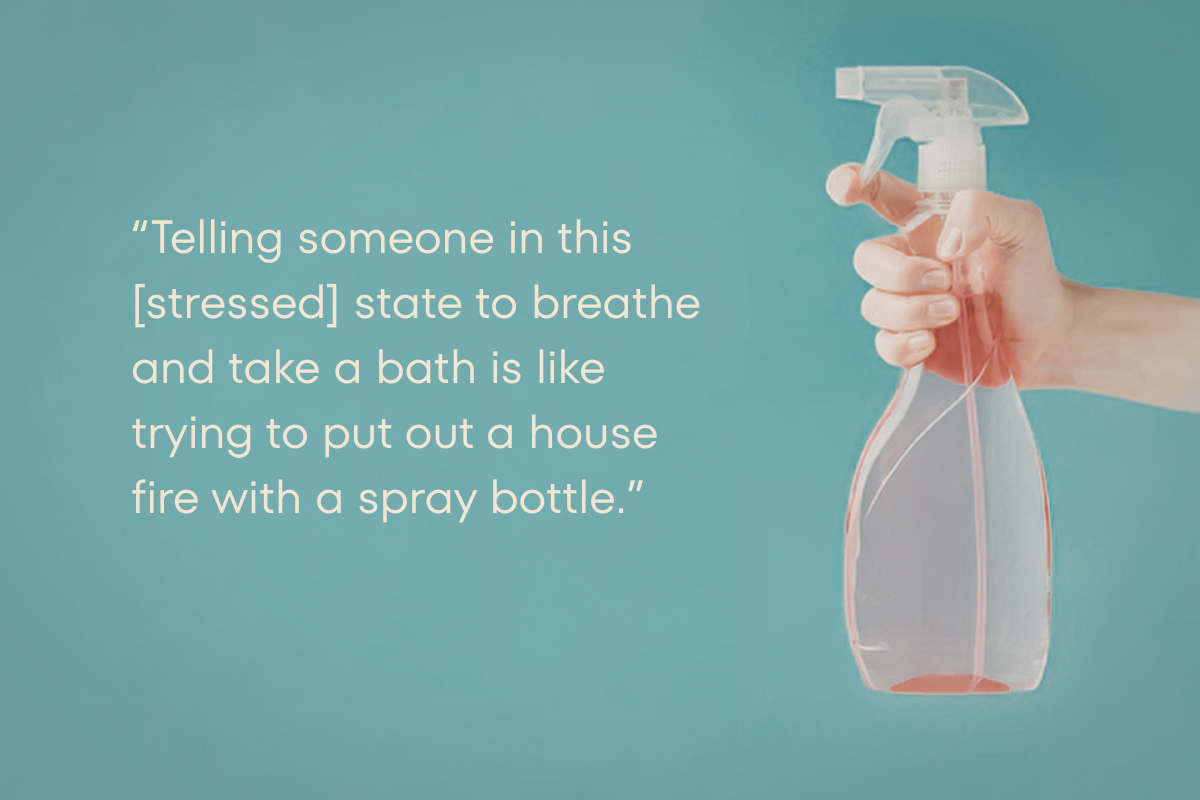
Telling someone in this state to breathe and take a bath is like trying to put out a house fire with a spray bottle. It doesn’t touch what’s actually happening.
Why the Tools Stop Working
Your nervous system has two primary modes.
Sympathetic is the gas pedal. Fight or flight. Perfect for outrunning a real threat and completely unsustainable as a daily baseline.
Parasympathetic is the brakes. Rest, digest, and repair. In a functional system, you move between these two states naturally.
For most people carrying a heavy load, the pendulum gets stuck on the gas.
At some point, this stops working. The body gets disoriented. The engine starts to smoke.
What Acupuncture Does
Acupuncture is not magic and it’s not about finding your zen.
When needles are placed into specific points, electrical signals are sent to your brain. The hypothalamus stops signaling for cortisol to flood your bloodstream.
The vagus nerve, the physical pathway of the braking system, sends signals to your gut and internal organs to do their thing because the body now registers as safe.
In this way, acupuncture invites the physiological shift that is so hard to make on your own when you’re stuck. Your body actually wants to drop the load. We have a name for it: “Acu-land.”
The deep relaxation that follows is not the goal. The goal is re-training your internal hardware to function without a constant emergency. Once your body gets a taste of that, it’s like drinking to quench a thirst you almost forgot you had.

Does it hurt???
The most common question is whether the needles hurt. Most people don’t feel much.
About ten minutes in, you experience the downshift. The internal hum starts to quiet. Your shoulders, which have been acting like earrings for three months, finally drop.
You feel heavy and grounded in a way you haven’t in a long time.
That’s what neutral actually feels like.
If You’re in the Upper Peninsula
I spent a decade as a VA community care provider learning to work with nervous systems that had been in survival mode for years. That’s the foundation of what happens in this clinic.
We use East Asian medicine because it was built for exactly this. Not to manage symptoms. To restore the system that creates them.
Your body already knows how to do this. Book an appointment and let’s remind it.
More about in person services here: https://keweenawacupuncture.janeapp.com/
If You’re Not in The Area
The invisible load doesn’t care where you live.
If you’re carrying that unexplainable exhaustion, start with my Invisible Load Assessment. It’s free and it helps you name what you’re actually holding. Naming it is the first step toward stopping the leak.
Here’s the Reality
Every day you stay in high-alert costs you something. Your sleep. Your health. Your ability to actually be present in your own life.
It’s not that you’re on the edge of burnout. It’s that you have a high capacity to carry a lot without burning out. But that capacity has a ceiling.
Being the martyr and doing it alone is optional.
The decision to put the load down is yours.